The 28-day cube result lands on your desk. It reads 12% below the specified characteristic strength. The concrete supplier is already on the phone, disputing the finding. The project manager wants answers. And somewhere between the batching plant and the compression machine, something went wrong. This scenario plays out in laboratories and site offices across the UK every week. The financial consequences are brutal delayed formwork stripping, contractual penalties, potential demolition of recently poured elements, and the erosion of client confidence.
A single erroneous cube result can derail a project timeline by weeks and add tens of thousands of pounds in unnecessary remedial work. Yet the concrete itself is often innocent. The problem usually lies in how the specimen was made, handled, cured, or tested. Understanding what corrupts cube test accuracy isn’t academic pedantry it’s the difference between a project that stays on track and one that spirals into dispute.
The Specimen That Never Was: Sampling and Representation
Concrete is not a homogeneous material. Aggregate particles, cement paste, and entrapped air distribute unevenly throughout a truckload. Taking a sample from the first half-barrow of discharge and assuming it represents the entire batch is a fundamental error that introduces variability before testing even begins. Proper sampling requires collection from multiple points across the discharge stream. BS EN 12350-1 specifies the procedure, but site pressure often shortcuts the process. The result? A cube that reflects the fines-rich portion of the mix rather than the true composite, yielding strength readings that bear no relationship to the structural element being evaluated.
The quantifiable cost: A 2018 survey of UK testing laboratories found that improper sampling accounted for approximately 18% of all out-of-specification cube results that were subsequently traced back to procedural errors. That translates to hundreds of unnecessary concrete investigations annually.
The Geometry Problem: What Your Mould Is Doing to Your Results
Concrete cube testing relies on a deceptively simple premise: crush a precisely dimensioned specimen and calculate compressive strength by dividing the failure load by its cross-sectional area. But that calculation is only as accurate as the specimen’s geometry. A mould that deviates from true dimensions by 0.5 millimetre on each side introduces a cross-sectional area error of approximately 1.3%. That might sound negligible until you calculate the strength overestimation or underestimation that follows. For a 150mm cube specified to achieve 40 MPa, that geometric error alone can shift the reported result by more than 0.5 MPa enough to push a marginal batch into failure territory.
The problem compounds when moulds wear. Repeated use, improper cleaning, and the inevitable dents and scratches from site handling gradually deform the internal cavity. Cast iron moulds, while durable, suffer from surface degradation over time. Plastic alternatives offer better dimensional stability when manufactured to specification, but inferior products lack the precision required by BS EN 12390-1. CAPCO’s moulds address this through precision machining to ±0.2mm tolerances, with each unit individually serialised for traceability. The two-part design with diagonal joint enables clean demoulding without damaging specimen corners a feature that directly impacts the surface condition of the finished cube.
The quantifiable cost: Research published in the Journal of Materials in Civil Engineering demonstrated that non-planar cube surfaces can reduce measured compressive strength by up to 15% compared to properly finished specimens. For a 50 MPa design mix, that’s a potential 7.5 MPa penalty entirely unrelated to the concrete’s actual quality.
The Compaction Blind Spot: Why Your Vibrating Table Might Be Lying to You
Every laboratory has a vibrating table. Most assume it works. Few verify it.
Fresh concrete is a three-phase system: aggregate, cement paste, and air. Compaction exists to expel as much of that entrapped air as possible. Incomplete compaction leaves voids that reduce the effective cross-sectional area bearing load in the hardened cube. The result underestimates the true potential of the mix. The margin is not trivial. Studies published in the Journal of Advanced Concrete Technology demonstrate that a 5% increase in air void content can reduce compressive strength by 20% or more, with the effect becoming more pronounced at higher strength grades. A cube that should read 60 MPa reads 48 MPa. The concrete is fine. The compaction was not.
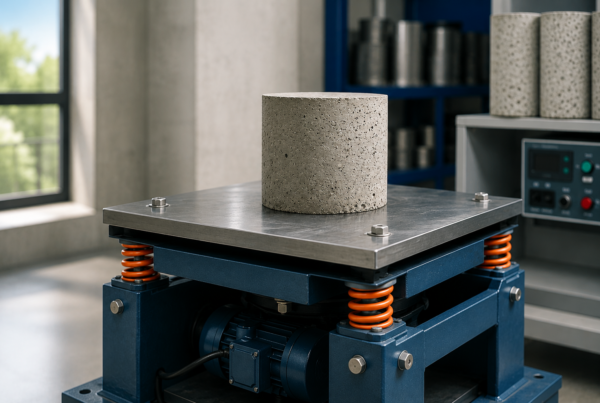
The British and European standard governing specimen manufacture, BS EN 12390-2, accepts hand tamping, vibrating tables, and internal poker vibrators as equivalent methods. Equivalent in principle but only when executed to the full requirements of the standard. Hand tamping varies between operators. Poker vibrators introduce variability in insertion depth and dwell time. And the vibrating table sits at the centre of this reproducibility challenge, its consistency taken on trust far more often than verified. Energy transmits from the table through the mould wall and into the concrete. This indirect transmission path means that table flatness, clamp integrity, and the presence of debris between mould and surface directly influence how much energy reaches the material. A mould that is not rigidly clamped bounces independently of the table, dissipating energy and leaving the concrete under-compacted. A worn rubber mount on one corner induces a rocking motion rather than pure vertical oscillation, creating zones of differential compaction within the same cube.
CAPCO’s vibrating tables are engineered to maintain consistent amplitude and frequency, with robust clamping mechanisms that ensure positive energy transfer. The difference between a verified table and an unverified one can be 10 MPa or more on a 50 MPa mix. The quantifiable cost: A laboratory that verifies its vibrating table performance annually checking amplitude, frequency stability, and table flatness can reduce compaction-related variability by an estimated 40%. That translates to fewer disputed results, fewer retests, and faster project sign-off.
The Curing Trap: What Happens When Hydration Stops
Cement hydration is a chemical reaction that requires uninterrupted access to moisture and stable thermal conditions. Interrupt that reaction, and the internal crystal matrix stops developing. Micro-fissures form. The concrete becomes brittle. And the cube test result drops. The first 24 hours are critical. Allowing specimens to dry out during this period permanently reduces the maximum load capacity of the concrete matrix. Yet site conditions frequently work against proper curing drying winds, direct sunlight, temperature extremes, and the simple pressure to move samples to the lab quickly all conspire to compromise hydration.
BS EN 12390-2 specifies storage at 20°C ± 5°C, covered with damp sacking or plastic sheeting to retain moisture. But adherence varies. A 2022 audit of UK testing facilities found that 34% of laboratories failed to maintain consistent curing temperatures, and 22% could not demonstrate adequate humidity control during the initial storage period. The quantifiable benefit: Maintaining perfect moisture retention can yield up to a 15% increase in final compressive strength compared to poorly cured field samples. This structural gain allows engineers to authorise early formwork stripping, reducing total project timelines by days or even weeks.
CAPCO’s curing tanks are designed to maintain precise temperature and humidity control, eliminating the variability introduced by improvised site storage. For laboratories handling high volumes of specimens, this consistency translates directly to reduced testing disputes and faster client reporting.
The Machine That Measures: Calibration and the Compression Test
The compression testing machine is the final arbiter. If it is inaccurate, everything that preceded it is wasted effort. BS EN 12390-4 specifies the performance requirements for compression testing machines used to measure hardened concrete compressive strength. The standard recognises three classes of testing machine corresponding to scale accuracies of 1%, 2%, and 3%. A machine operating at Class 3 accuracy on a 40 MPa cube introduces a potential error of ±1.2 MPa before any other variable is considered.
Calibration is not a one-time event. Machines drift. Load cells degrade. Hydraulic systems develop leaks. Platens become misaligned. The UKAS requirement for annual calibration is the minimum high-volume laboratories often calibrate quarterly to maintain confidence in their results. Beyond calibration, the testing procedure itself introduces variability. Specimen alignment in the load frame affects stress distribution. A cube that is even slightly off-centre experiences eccentric loading, which reduces the measured failure load. The rate of load application matters too—too fast and the cube fails artificially high; too slow and the sustained stress causes creep deformation that lowers the recorded strength.
The Human Factor: Why Operators Are the Largest Variable
Machines can be calibrated. Procedures can be standardised. But the person holding the tamping bar, reading the gauge, and recording the data remains the single largest source of variability in concrete cube testing.
Research comparing manual and mechanised testing procedures found that manual handling makes the major contribution to variability in strength development. The manual factor can account for most if not all of the variation observed at 28 days. This is not a criticism of individual competence. It is a recognition that human beings are inconsistent. Fatigue, distraction, time pressure, and simple variation in physical technique all introduce differences that the concrete itself does not possess.
The solution lies in standardisation and verification. Written procedures that specify every action. Regular competency assessments. Automated equipment that reduces the scope for manual error. And a culture that treats testing as the serious technical discipline it is, rather than a box-ticking exercise.
The Temperature and Moisture Effect: The Variables Nobody Controls
Two factors are rarely discussed in concrete testing literature, yet they consistently corrupt results: the temperature at which specimens are made and the moisture condition of the cube at the moment of testing. Fresh concrete temperature affects setting behaviour and early strength development. Research has demonstrated that allowing concrete to set at elevated temperatures 55°C, for example produces measurable strength reductions compared to specimens from the same batch cured at standard ambient conditions. Site conditions in summer months frequently exceed this threshold, yet few laboratories record the temperature of the concrete at the time of casting.
Moisture condition at testing is equally critical. A wet surface gives rise to underestimated strength when compared to specimens calibrated under dry conditions. The difference can be several MPa on a standard 28-day test. Standards specify that specimens should be tested in a saturated surface-dry condition, but achieving this consistently requires discipline and the right equipment.
What to Do About It: Practical Steps for Better Accuracy
The factors outlined above are not theoretical. They are daily realities in laboratories and site offices across the UK. But they are also manageable. Here is what works:
Verify your moulds. Check dimensions regularly. Replace worn units. CAPCO’s moulds are manufactured to ±0.2mm tolerances and individually serialised for traceability.
Calibrate your vibrating table. Amplitude, frequency, and table flatness all affect compaction energy. Verify them annually at minimum.
Control your curing environment. Temperature and humidity matter. CAPCO’s curing tanks provide the consistent conditions that BS EN 12390-2 requires.
Calibrate your compression machine. Annual UKAS calibration is the baseline. Consider quarterly verification for high-volume operations.
Train your operators. Competence is not assumed—it is demonstrated. Regular assessment reduces variability.
Document everything. Chain of custody, environmental conditions, equipment verification—if it is not recorded, it did not happen.
Final Thought
Concrete cube testing is not a formality. It is the primary mechanism by which the construction industry verifies that the material holding up buildings, bridges, and roads is fit for purpose. When the test is inaccurate, the consequences are not theoretical they are structural, financial, and occasionally catastrophic. The factors that compromise accuracy are well understood. They are also preventable. The question is whether your laboratory, your site team, and your equipment supplier are doing what is necessary to prevent them.
CAPCO Test Equipment has been manufacturing testing equipment for over half a century. The company’s range encompasses everything from cube moulds and tamping bars to vibrating tables and compression testing machines. Every product is engineered to the standards that matter BS EN, ASTM, and the other international specifications that underpin reliable concrete testing. Because when the cube result lands on your desk, it should tell you the truth about the concrete. Not the story of a mould that was out of tolerance, a table that was underperforming, or an operator who was having a bad day.