Modern structural engineering relies heavily on high-performance concrete mixes capable of navigating dense rebar cages without requiring mechanical vibration. When fresh concrete is poured into complex formwork, ensuring complete encapsulation without honeycombing or structural voids becomes the ultimate priority for quality control teams.
Evaluating highly flowable concrete requires a distinct shift in testing philosophy. When a mix possesses high workability, placing it in a standard vertical cone leads to immediate collapse rather than a measurable vertical drop. In these situations, measuring the horizontal spread of the mixture across a flat, rigid base plate provides the true indicator of its rheological behavior. This measurement reveals critical insights into how the material will behave during actual placement, highlighting both its yield stress and visual stability under gravity alone.
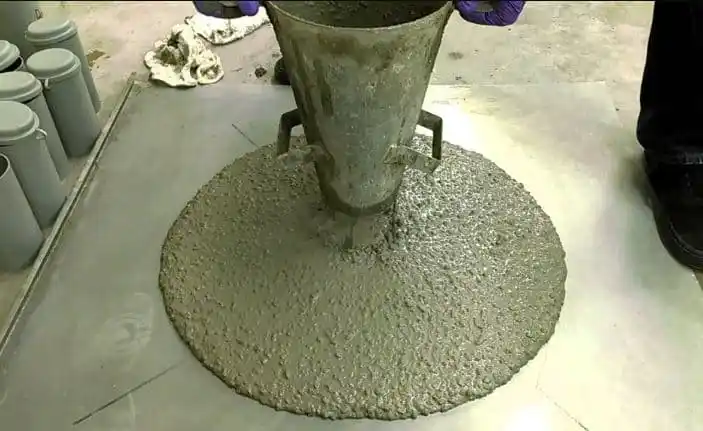
Executing a standardized Slump Flow Test allows site technicians and materials engineers to evaluate two crucial characteristics simultaneously: horizontal flowability and resistance to segregation. During this procedure, an inverted or upright Abrams cone is filled with uncompacted fresh concrete on a damp, non-absorbent base plate, after which the cone is lifted smoothly vertically.
As the concrete spreads outwards in a circular mass, observers measure the final mean diameter of the circle as well as the time taken to reach a diameter of 500 millimeters, known as the T500 time. This straightforward measurement gives project teams complete confidence that the batch can fill intricate formwork smoothly without blocking or bleeding.
Understanding the Core Dynamics of Self-Consolidating Concrete Workability
Self-consolidating concrete represents a significant leap forward in materials technology, enabling rapid placement and exceptional structural integrity in heavily reinforced elements. Unlike conventional mixtures that depend on external vibration to eliminate entrained air pockets, fluid mixes flow into every crevice solely under their own gravitational weight.
Achieving this state requires a delicate balance between high deformability and adequate cohesion. If the mix lacks sufficient viscosity, coarse aggregates settle to the bottom, causing severe segregation that compromises the structural strength of the finished element.
The physics governing fluid concrete behavior revolves around two primary rheological properties: yield stress and plastic viscosity. Yield stress determines the minimum force needed to initiate movement, while plastic viscosity governs the rate of flow once motion begins. In field environments, monitoring these parameters ensures that batches remain uniform throughout the pour.
A batch with an excessively wide horizontal spread might indicate an over-dosed superplasticizer, whereas a sluggish spread signals insufficient water-reducing agents or batching variations that could lead to incomplete form filling.
Essential Equipment Setup and Calibration Standards
Accurate test outcomes depend heavily on the quality, dimensional precision, and condition of the testing apparatus. The core assembly consists of a standard steel or plastic Abrams cone, a rigid base plate constructed from non-absorbent material, a stopwatch, a steel ruler or measuring tape, and a damp cloth. The base plate must be perfectly level and rigidly supported to prevent any flexure or movement during concrete discharge.
Etched concentric circles, particularly at 210 millimeters and 500 millimeters diameters, marked on the center of the base plate assist technicians in centering the cone and visually tracking the expanding circle. Cleanliness and moisture control on the base plate surface play a decisive role in eliminating frictional resistance. Prior to pouring, the base plate and interior cone surfaces must be thoroughly cleaned of dry cement residue and wiped down with a damp cloth to create a uniform surface condition.
Excessive water or leftover standing droplets on the plate will artificially lubricate the flow path, yielding inflated spread dimensions. Conversely, a bone-dry or rough base plate creates boundary friction that dampens horizontal movement, producing misleadingly conservative measurements that fail to reflect actual batch potential.
Step-by-Step Procedure for Measuring Spread and T500 Flow Speed
Executing the physical evaluation requires disciplined adherence to standardized guidelines, such as BS EN 12350-8 or ASTM C1611. The technician places the cone centrally on the leveled base plate, holding it down firmly using foot pieces or manual pressure to prevent concrete from leaking beneath the bottom rim during filling.
Freshly sampled concrete is poured into the cone in a single continuous lift without any tamping or mechanical rodding. Filling the cone without rodding allows the intrinsic weight of the material to govern its density, reflecting the self-compacting nature of the mix design.
Once filled, excess concrete is struck off level with the top rim using a flat trowel, and any spilled material around the base of the cone is wiped clean. The operator then smoothly lifts the cone vertically in a single continuous motion, taking roughly two to three seconds, without imparting lateral or torsional forces to the fluid concrete.
As soon as the cone loses contact with the base plate, a second operator starts the stopwatch to record the exact duration required for the perimeter of the expanding concrete cake to reach the 500 millimeter concentric circle. This duration represents the T500 flow time, serving as a direct indicator of plastic viscosity.
Interpreting Visual Stability Index and Rheological Performance
After the concrete movement halts completely, technicians record two perpendicular diameters across the spread mass to calculate the average slump flow value. Typical specification target ranges fall between 550 millimeters and 850 millimeters, depending on structural requirements and rebar spacing density. Beyond measuring raw diameter, observing the visual condition of the spread concrete yields essential qualitative data known as the Visual Stability Index (VSI).
The Visual Stability Index rates the segregation resistance on a scale from 0 to 3. A VSI score of 0 denotes a stable mix with uniform aggregate distribution right up to the edge of the circular spread, accompanied by no free water or paste halo. A score of 1 indicates slight segregation, where a faint mortar halo appears along the outer boundary without aggregate pile-up.
A score of 2 signals clear segregation with a distinct paste ring and aggregate concentration near the center, while a score of 3 represents severe segregation, characterized by a large mortar halo, complete aggregate separation, and obvious bleeding. Maintaining a VSI score of 0 or 1 is vital for structural reliability.
Troubleshooting Common Field Anomalies and Segregation Issues
When field measurements diverge from target design parameters, rapid diagnostic troubleshooting prevents costly structural defects and placement delays. If the flow diameter is too narrow, the root cause often stems from batching moisture fluctuations, extended agitation times in transit mixers, or insufficient high-range water reducer dosage.
Adding water on site to restore flowability without adjusting cementitious content degrades long-term compressive strength and durability, making precise admixture adjustments under qualified supervision the preferred remedial action.
Conversely, an excessively fast T500 time combined with border paste halos points toward over-dosage of chemical admixtures or improper fine aggregate gradations. To remedy segregation without sacrificing flow spread, concrete technologists adjust the mix design by introducing viscosity-modifying agents (VMAs) or increasing the proportion of ultra-fine mineral additives such as fly ash or limestone powder.
These fine particles enhance cohesion and internal matrix shear resistance, ensuring that coarse aggregates remain evenly suspended while the fluid mass fills formwork around dense steel reinforcement.
Impact of Superplasticizers and Mix Proportions on Flow Behavior
The remarkable flow properties of self-compacting concrete are made possible by advanced polycarboxylate ether (PCE) superplasticizers. These high-range water reducers adsorb onto the surfaces of cement particles, imparting strong electrostatic repulsions and steric hindrance that break up cement agglomerates. This mechanism releases trapped water molecules, enabling the mixture to achieve high fluid mobility at significantly lower water-to-cementitious ratios than traditional concrete mixes.
Balancing aggregate grading is equally essential for achieving ideal rheological performance. Fine aggregates must supply sufficient paste volume to coat coarse aggregate surfaces, reducing internal particle friction during flow. Incorporating well-graded sand and optimizing coarse aggregate size, typically limiting maximum aggregate size to 16 or 20 millimeters, prevents mechanical interlock when fluid concrete squeezes through narrow rebar gaps. Continuous lab verification ensures that the interaction between chemical admixtures and cementitious materials yields consistent, repeatable workability performance.
Precision Manufacturing Standards for Materials Testing Equipment
Achieving repeatable and compliant material testing results in civil engineering depends on using robust, high-precision laboratory and site apparatuses. Over half a century of engineering expertise in manufacturing civil engineering test equipment has established strict benchmarks for precision testing assemblies.
From heavy-duty steel slump cones and precision-machined base plates to calibrated tamping rods, spreading table sets, and specialized concrete cube moulds, high-quality manufacturing ensures full compliance with British and international testing standards.
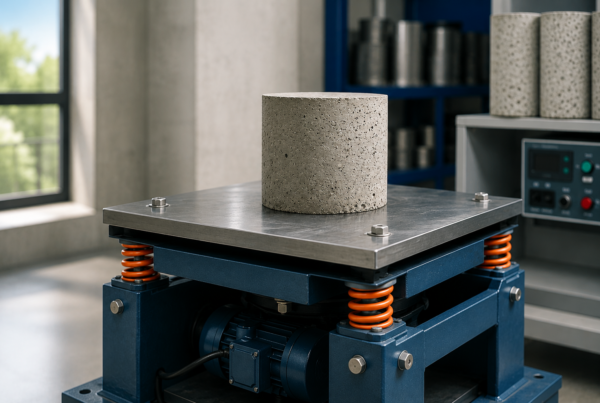
Comprehensive material testing facilities rely on specialized sample preparation tools, including digital air meters, curing tanks with precise temperature logging, Vicat apparatuses, sieves, and vibrating tables.
Utilizing meticulously engineered equipment eliminates apparatus-induced variances, giving site engineers and laboratory managers total confidence in their fresh and hardened concrete quality assurance protocols. Investing in durable, high-tolerance testing apparatus safeguards structural projects against material non-compliance and ensures seamless site operations across all phases of construction.
Final Insights
Implementing rigorous testing methodologies guarantees that high-performance concrete mixtures maintain structural integrity from mixing plant to final curing. Precise evaluation of fresh concrete behavior mitigates risks related to honeycombing, poor consolidation, and costly structural remediations, giving field teams absolute control over placement consistency.
Continuous monitoring of rheological properties allows engineers to adapt mix proportions to varying ambient site conditions, aggregate moisture shifts, and transit delays. Standardizing field procedures across all project phases builds a reliable empirical dataset, ensuring that every batch meets rigorous durability and strength criteria before placement begins.