It is the phone call no laboratory manager wants to receive. A set of 28-day cube results has come back 12% below the specified characteristic strength. The concrete supplier is contesting the findings. The contractor is demanding answers. And somewhere in the chain of custody—from batching plant to testing laboratory—something went wrong. The investigation, when it runs its course, will examine the mix design, the curing regime, the cube mould condition, and a dozen other variables. But there is one factor that routinely escapes scrutiny despite being present at the very moment the specimen was created: the compaction energy delivered to that fresh concrete before it ever entered the curing tank. In laboratories across the country, that energy comes from a machine that hums away in the corner, rarely questioned, and often assumed to be performing adequately simply because it vibrates when switched on.
The British and European standard governing the manufacture of concrete test specimens, BS EN 12390-2, makes a statement that many technicians have read but few have truly absorbed: compaction by hand tamping, vibrating table, or internal poker vibrator are accepted as equivalent methods. Equivalent in principle, but only when each is executed to the full requirements of the standard. The reality on the ground is less tidy. Hand tamping varies between operators. Poker vibrators introduce variability in insertion depth and dwell time. And the vibrating table—the workhorse of the laboratory—sits at the centre of this reproducibility challenge, a machine whose consistency is taken on trust far more often than it is verified. When a cube fails, the assumption races toward the concrete. The table is rarely the suspect. It should be.
The Compaction Compromise: Understanding What a Surface Vibrator Actually Does
Fresh concrete, as delivered to a mould, is a three-phase system: aggregate, cement paste, and air. The function of compaction is to remove as much of that entrapped air as possible, consolidating the solid constituents into a dense, homogeneous mass. Incomplete compaction leaves air voids that reduce the effective cross-sectional area bearing load in the hardened cube, producing a compressive strength result that underestimates the true potential of the mix. The margin is not trivial. Studies published in the Journal of Advanced Concrete Technology have demonstrated that a 5% increase in air void content can reduce compressive strength by 20% or more, with the effect becoming more pronounced at higher strength grades. A cube that should have read 60 MPa reads 48 MPa. The concrete is fine. The compaction was not.
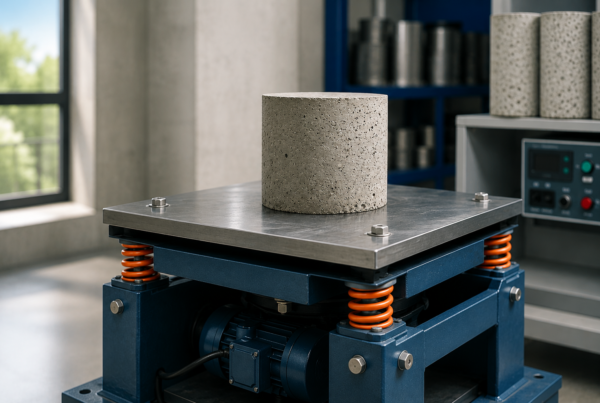
Laboratory vibrating tables generate compaction through vertical oscillation, typically operating at mains frequency (50 Hz in the UK) with an amplitude determined by the mass of the offset weight and the stiffness of the mounting system. The concrete mould is clamped to the table surface, and the entire assembly vibrates. Energy transmits from the table, through the mould wall, and into the concrete. This indirect transmission path means that the condition of the interface—the flatness of the table, the integrity of the clamp, the presence of debris between mould and surface—directly influences how much energy reaches the material. A mould that is not rigidly clamped will bounce independently of the table, dissipating energy and leaving the concrete under-compacted. A worn rubber mount on one corner of the table will induce a rocking motion rather than pure vertical oscillation, creating zones of differential compaction within the same cube.
Threaded rod adjustment is not a feature commonly associated with vibrating tables, but the principle of mechanical adjustment—ensuring level, ensuring secure clamping, and verifying that the table platform is parallel to the base—applies to every table in service. The CAPCO Light Duty Vibrating Table, for instance, incorporates a steel body with a powder-coated finish and a vibrator motor with an offset weight mounted to the underside. The table is attached to the base by rubber mounts that isolate vibration from the surrounding bench and, critically, influence the resonant behaviour of the system. If those rubber mounts degrade—hardening with age, cracking from ozone exposure, or compressing unevenly under sustained load—the table no longer oscillates as designed. The amplitude drops. The compaction diminishes. The cube results begin to drift. No one notices until a pattern of low strength emerges, and by then, months of data may be compromised.
The Cost Spectrum of Poor Compaction
The financial and operational impact of unreliable compaction extends across multiple dimensions. The numbers that follow are drawn from real laboratory audit findings and published industry investigations into cube strength variability.
- False Strength Failures: A systematic under-compaction error of just 10%—easily introduced by a vibrating table operating below its specified amplitude—can reduce measured 28-day compressive strength by 8 to 15%. For a laboratory processing 200 cubes per month, this can translate to 15 to 20 false failures annually. Each failure triggers investigation costs, re-sampling, and potential contractual disputes. Industry estimates place the fully burdened cost of resolving a single disputed cube result at £450 to £800. Over a year, the unnecessary cost burden exceeds £10,000.
- Inter-Laboratory Reproducibility Gaps: Proficiency testing schemes, such as those administered by UKAS-accredited providers, have identified vibrating table condition as a statistically significant contributor to inter-laboratory variability. Laboratories using calibrated, well-maintained tables consistently cluster around the median strength value. Laboratories with tables of unknown calibration history show wider scatter, undermining their standing in proficiency assessments and, increasingly, their eligibility for specified contract work.
- Over-Design and Material Waste: The reverse scenario occurs when a laboratory’s vibrating table is known to under-compact, and the concrete supplier compensates by systematically increasing the cement content of every mix to achieve a safety margin on cube results. A 5% cement over-addition across a medium-sized ready-mix operation adds approximately £50,000 to annual material costs and carries an embodied carbon penalty of 30 to 40 tonnes of additional CO₂.
- Audit Exposure: UKAS technical assessors are now asking laboratories to demonstrate that their compaction equipment is fit for purpose. A calibration certificate for the vibrating table—confirming frequency, amplitude, and timer accuracy—is becoming standard audit documentation. Laboratories unable to produce such evidence face non-conformances that can delay or jeopardise accreditation scope.
Calibration and Verification: What a Defensible Regime Looks Like
A vibrating table is a measurement instrument, not a generic workshop appliance. The parameter that matters most—the amplitude of the table surface during operation—is not displayed on a dial. It must be measured. The standard method uses a calibrated accelerometer or displacement transducer placed at a defined location on the table platform, with the table running under load equivalent to a filled cube mould. The measured peak-to-peak displacement should fall within the range specified by the table manufacturer, typically 0.3 to 0.7 mm for a light-duty laboratory table, and must be consistent across repeated measurements. A deviation of more than ±10% from the nominal amplitude warrants investigation and, if not correctable through maintenance, removal from service.
Frequency verification is the second essential check. Mains-powered vibrator motors are designed to operate at 50 Hz, but voltage fluctuations, bearing wear, and mechanical loading can shift the actual operating frequency. A handheld tachometer or strobe can confirm that the motor is running at its design speed. Timer verification, using a calibrated stopwatch, confirms that the compaction duration—typically 60 to 120 seconds depending on the concrete mix and the mould geometry—is being delivered accurately. A timer that drifts by 5 seconds on a 90-second compaction cycle introduces a 5.5% variation in energy input, sufficient to measurably affect cube strength.
The calibration schedule recommended by equipment specialists and aligned with ISO 17025 expectations suggests a full amplitude and frequency check every 6 months for tables in daily use, with annual verification sufficient for lower-throughput laboratories. After any incident—a table being moved, a heavy impact, or a noticeable change in noise or vibration character—the calibration should be repeated immediately. Documentation of these checks must be retained as part of the laboratory’s quality records, linked to the specific table by serial number, and made available during surveillance audits.
Rubber Mounts and the Mechanics of Decay
The rubber isolation mounts that sit between the table platform and the base frame are consumable components, not permanent fixtures. Natural rubber and synthetic elastomers degrade over time through oxidation, ozone attack, and cyclic fatigue. A mount that has been in service for three years in a typical laboratory environment—exposed to cement dust, fluctuating temperatures, and continuous loading—will have lost a measurable fraction of its original stiffness. As stiffness decreases, the resonant frequency of the table system shifts, and the amplitude at the operating frequency changes in response. The table may continue to vibrate, but it is no longer vibrating at the energy level for which it was designed.
Visual inspection of rubber mounts should be part of the weekly housekeeping routine. Signs of degradation include surface cracking, permanent compression set (where the mount no longer returns to its original height when unloaded), and uneven deformation indicating that one mount is carrying more load than the others. Mounts should be replaced as a complete set, not individually, to maintain balanced support. The cost of a set of replacement mounts for a typical light-duty vibrating table is approximately £30 to £60—the equivalent of processing one or two disputed cube results. On a cost-risk basis, replacing mounts preventatively every 24 months is an inexpensive insurance policy against compaction drift.
Surface Flatness and Mould Clamping
The table platform on which the cube mould sits must be flat to ensure uniform contact between the mould base and the vibrating surface. A platform that has been dented, scored, or distorted through rough handling creates air gaps and uneven energy transmission. BS EN 12390-2 requires that moulds be firmly attached to the vibrating table, and a table surface that is not flat makes firm attachment impossible to achieve consistently across multiple moulds. The platform flatness should be checked with a straightedge and feeler gauge during the calibration visit, with a tolerance of 0.5 mm across the full platform width.
Clamping mechanisms—whether toggle clamps, screw clamps, or magnetic holders—must apply sufficient force to prevent mould movement during vibration without deforming the mould itself. A clamp that has loosened through vibration will allow the mould to dance on the table surface rather than vibrating in sympathy with it. The energy that should be compacting concrete is instead being dissipated as noise and heat at the loose interface. Weekly checks of clamp function, and immediate tightening or replacement of any clamp that does not lock positively, prevent this mode of failure before it reaches the cube.
Noise, Operator Comfort, and Duty of Care
A vibrating table operating at 50 Hz with a steel mould clamped to it produces noise levels typically in the range of 68 to 78 dB at one metre. In a small laboratory enclosure, with hard reflective surfaces, the perceived noise can reach 82 to 85 dB—a level at which the Control of Noise at Work Regulations 2005 require employers to provide hearing protection and, above 85 dB, to designate hearing protection zones. Tables with degraded rubber mounts or loose clamps are significantly noisier than well-maintained units, because the mechanical energy that should be transmitted into the concrete is instead being radiated as airborne sound.
Rubber isolation mounts serve a dual purpose, reducing both the noise emitted by the table and the vibration transmitted through the bench to adjacent equipment. A laboratory that processes cube samples on the same bench where sensitive balances are located is inviting a cross-contamination of measurement error. The anti-vibration design of the table should be matched by common-sense laboratory layout: vibrating tables placed on separate, rigid benches isolated from precision weighing and dimensional measurement stations.
The Shifting Landscape: Advanced Mixes and Compaction Demands
Concrete technology is not standing still. The UK construction industry’s commitment to reducing embodied carbon, codified in standards such as PAS 2080 and reinforced by the updated BS 8500, is accelerating the adoption of low-clinker concretes. These mixes—containing high volumes of ground granulated blast-furnace slag, fly ash, and limestone fines—exhibit rheological properties that differ markedly from traditional CEM I concretes. They are often more cohesive, with higher plastic viscosity, and require greater compaction energy to achieve equivalent consolidation. A vibrating table that was adequate for a traditional CEM I mix may under-compact a low-carbon alternative, producing cube results that unfairly penalise the more sustainable material.
This trend is intersecting with another development: the increasing use of self-compacting concrete, which by definition requires no mechanical compaction. The paradox is that while some concretes are moving away from the need for vibrating tables, the concretes that do require compaction are becoming more demanding of the equipment used to consolidate them. A laboratory that fails to recognise this shift and continues to operate a vibrating table of unknown calibration will find itself generating data that is increasingly disconnected from the true performance of the materials it is testing.
Frequently Asked Questions
What is the purpose of a vibrating table in a concrete laboratory?
A vibrating table consolidates fresh concrete in cube or cylinder moulds by applying controlled mechanical vibration. This removes entrapped air voids and ensures the concrete is dense and homogeneous before curing. Proper compaction is essential for the measured compressive strength to accurately represent the concrete as supplied.
Which standard governs the use of vibrating tables for concrete specimen preparation?
BS EN 12390-2 specifies the methods for making and curing test specimens for strength tests. It accepts compaction by hand tamping, vibrating table, or internal vibrator as equivalent, provided each method is applied correctly and the equipment meets the necessary performance requirements.
How does a vibrating table differ from an immersion (poker) vibrator?
A vibrating table applies external vibration through the mould from beneath, making it ideal for multiple small specimens in a laboratory setting. An immersion vibrator is inserted directly into the concrete, delivering energy more efficiently for large volumes and deep sections. The table provides consistent, repeatable compaction across specimens, while the poker vibrator’s effectiveness depends heavily on operator technique.
How often should a laboratory vibrating table be calibrated?
For tables in daily use, calibration of amplitude, frequency, and timer accuracy should be conducted every six months. Laboratories with lower throughput may extend this to an annual check. Calibration must be repeated after any event that could affect performance, such as relocation or impact damage. Documentation should be retained for audit purposes.
What are the signs that a vibrating table is not performing correctly?
Warning signs include: a change in the characteristic sound during operation, visible uneven vibration or rocking motion, cubes that consistently show surface voids or honeycombing, a drift in compressive strength results compared to historical averages or proficiency testing medians, and increased noise levels above the normal operating range.
How do rubber mounts affect vibrating table performance?
Rubber isolation mounts determine the resonant behaviour of the table system and influence the amplitude delivered to the mould. Degraded mounts—hardened, cracked, or permanently compressed—alter the table’s vibration characteristics, typically reducing amplitude and introducing rocking motion. Mounts should be inspected weekly and replaced as a complete set every 24 months or sooner if degradation is visible.
What amplitude should a light-duty vibrating table operate at?
The optimal amplitude depends on the table design and the concrete mix being compacted. For a light-duty laboratory table, a peak-to-peak displacement of 0.3 to 0.7 mm under load is typical. The manufacturer’s specification should be confirmed, and the amplitude should be verified using a calibrated accelerometer or displacement transducer as part of the calibration schedule.
Can a vibrating table be used for materials other than concrete?
Yes. Vibrating tables are widely used in materials testing for compacting cement mortars, asphalt specimens, resin-bound materials, and grouts. Any material that requires void-free consolidation in a mould can benefit from controlled table vibration, provided the amplitude and frequency are appropriate for the material’s rheology.
What is the relationship between compaction and cube strength results?
Incomplete compaction leaves air voids in the hardened specimen, reducing the effective load-bearing area and producing a lower measured compressive strength. The reduction is not linear: a 5% air void content can reduce strength by 15 to 20% in higher-grade concretes. Consistent, verified compaction is essential for generating cube results that accurately represent the concrete’s true strength potential.
How should a vibrating table be cleaned and maintained on a daily basis?
After each use, remove concrete debris and cement dust from the table surface using a damp cloth. Do not allow hardened concrete to accumulate, as it will prevent proper mould seating. Check clamps for function, inspect rubber mounts for visible damage, and wipe down the motor housing. Weekly, verify that the table is level, and monthly, confirm that all fasteners are tight. A clean, level, well-maintained table is the foundation of reliable compaction.