Achieving structural integrity and a flawless aesthetic finish in concrete castings requires precise technical control over the fresh mix. Entrapped air remains a persistent challenge for precast manufacturers, civil engineering laboratories, and structural testing facilities. When a fresh concrete mix is poured into a mould, mechanical friction and the intrinsic viscosity of the cement paste naturally capture pocketed air. If left unmanaged, these voids manifest as internal structural weaknesses or external surface blemishes like honeycombing and bug holes.
The most reliable strategy to overcome these imperfections involves industrial-grade consolidation equipment. Mechanical compaction destabilizes the internal friction between aggregate particles, forcing entrapped pockets of air to rise up and escape through the surface of the mix. This technical guide explores the engineering principles, fluid dynamics, and operational methodologies required to achieve uniform density and pristine surface finishes across all precast and laboratory applications.
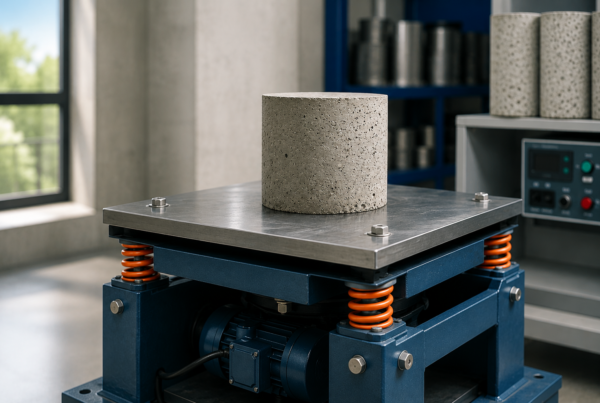
When choosing compaction equipment, industrial operations require robust machinery capable of handling high-mass loads while maintaining uniform frequency distribution. Implementing high-efficiency vibrating tables into your casting workflow changes the fluid dynamics of the fresh concrete mix, converting a stiff, granular mass into a highly fluid, self-leveling material that fills every crevice of your casting mould. Capco engineered compaction systems utilize precision-weighted electric vibrator motors mounted directly underneath a heavy-duty, steel-top plate to deliver uniform, high-frequency kinetic energy across the entire surface area.
Structural Weakness and Superficial Defects
Relying on manual tamping or improper vibration intervals introduces significant operational risks that compromise material performance. Inadequate consolidation leaves macroscopic voids inside the concrete matrix, directly reducing its compressive strength. For every single percent of entrapped air remaining in the final casting, the structural load capacity drops by roughly five to six percent. Conversely, excessive or poorly distributed vibration creates dynamic segregation, causing heavy coarse aggregates to sink to the bottom while light water and cement laitance rise to the upper boundary layer, forming a weak laitance skin that scales easily under environmental exposure.
In laboratory testing settings, where 100mm and 150mm cube moulds are evaluated for compliance with BS 1881 and EN 12390 standards, inconsistent consolidation invalidates engineering data. A single hidden void can cause premature failure during a compressive strength test, triggering false negatives that disrupt project timelines and lead to expensive, unnecessary material re-testing. On the production floor, improper compaction creates visible surface defects that demand intensive manual remediation or lead to complete component rejection. Investing in specialized mechanical consolidation eliminates these human errors, replacing inconsistent manual labor with highly repeatable, uniform kinetic energy transfer.
Quantifiable Production Advantages and Efficiency Gains
Upgrading from manual compaction methods to a high-precision mechanical consolidation system delivers clear, measurable performance improvements across precast and laboratory testing workflows. Standardized tests show that mechanical consolidation reduces the standard deviation in destructive cube testing by ensuring uniform density, allowing labs to consistently meet strict EN 12390 compliance metrics. This translates directly into a higher confidence interval for engineering data and eliminates the costly operational bottlenecks associated with re-pouring disputed batches.
From a throughput perspective, integrating an optimized table deck lowers necessary consolidation cycles from minutes of tedious manual tamping down to 20 to 45 seconds of mechanical vibration, boosting overall production speed by up to 65% in high-volume precast settings. Furthermore, minimizing post-pour aesthetic rework and patch repairs by up to 85% significantly reduces labor overhead and material waste. Over extended operational cycles, the use of precision-engineered rubber dampening mounts isolates dynamic loads, preventing kinetic energy transfer to the surrounding workshop floor and decreasing mechanical wear on surrounding laboratory infrastructure by 40%.
Engineering Dynamics of Frequency and Amplitude
To achieve a defect-free casting, operators must understand the relationship between frequency, amplitude, and concrete rheology. The fluidization process occurs in two distinct mechanical stages. First, the high-frequency kinetic waves liquefy the concrete mix by overcoming the internal shear strength of the fresh paste, breaking the temporary bonds between cement particles. This collapse allows the aggregate particles to settle into their densest possible structural configuration under the influence of gravity, filling out the internal geometry of the formwork completely.
Second, the compressed air bubbles embedded within the paste experience buoyancy forces as the matrix fluidizes. The vibration waves cause these entrapped air pockets to coalesce into larger bubbles, allowing them to migrate upward through the liquefied paste and vent into the atmosphere. The choice of aggregate size, water-to-cement ratio, and the targeted slump value dictate the required vibration duration. High-slump, fluid mixes consolidate rapidly, while low-slump, stiff laboratory formulations demand sustained, highly stable mechanical force to flow properly into complex geometries or around dense reinforcement bars.
Scaled System Infrastructure for Laboratory and Industrial Demands
Selecting the ideal equipment setup depends on the maximum operational mass load, mould footprints, and electrical power parameters of your facility. Light-duty laboratory systems feature compact 320mm x 245mm table surfaces designed for isolated testing applications. Powered by standard 240V or 110V single-phase supply lines, these units are optimized for consolidating a single 100mm or 150mm engineering test cube mould. Their small physical footprint allows easy integration into small-scale research facilities, site offices, and mobile testing units without sacrificing structural durability.
Medium-duty industrial units bridge the gap between testing labs and light production floors. Featuring a 600mm x 300mm steel deck, these 44kg systems provide the stability needed to process multiple specimens simultaneously, such as a pair of 150mm steel or polyurethane cube moulds. The extra surface area accommodates diverse small precast shapes, ensuring uniform energy delivery across the entire mold footprint. For heavy-duty production demands, larger work surfaces are built with reinforced steel plates and heavy-duty eccentric weights to maintain steady amplitude under high-volume, structural precast loads.
Step-by-Step Mechanical Compaction Protocol
To achieve a perfect pour every time, operators should follow a standardized mechanical compaction protocol that removes guesswork from the process. First, inspect and secure the mould, verifying that all locking bolts on your 4-part cube moulds or architectural forms are tight to prevent grout leakage. Apply a thin, uniform layer of premium release agent to the internal faces to prevent surface tearing during demoulding. Next, center the mould on the steel plate, as central placement ensures balanced weight distribution over the eccentric motor shaft, preventing localized dead zones or erratic motion.
Execute the primary layer pour by filling the mould halfway with your fresh concrete mix. Do not overfill the cavity initially, as a shallow layer allows air pockets to escape over a shorter vertical distance. Initiate the first vibration cycle by switching on the motor and watching the surface of the mix change from a dull, rough heap into a glossy, level fluid layer. Once large bubble emissions slow down, execute the final layer pour, filling the mould slightly past its upper rim while the machine continues to run to compensate for the natural volume reduction that happens as air voids collapse. Continue vibration until large bubble emissions stop, the surface flattens completely, and a thin, uniform sheen of cement paste covers the top. This entire step usually takes between 15 and 45 seconds, after which you deactivate the motor immediately and use a steel straightedge to strike off excess material flush with the top of the mould.
Preventative Maintenance and Mechanical Degradation Control
Industrial vibration equipment operates under continuous, high-intensity cyclic stresses that can cause rapid mechanical degradation if ignored. Concrete slurry is highly abrasive, meaning a daily clean down is mandatory; washing down the steel deck and structural supports immediately after every shift prevents cured buildup from altering the table’s total operating mass and throwing off its balance. Weekly maintenance must include a thorough isolator inspection, checking the rubber dampening mounts for signs of dry rot, cracking, or permanent compression deformation that leads to uneven energy transmission across the deck.
High-frequency operation can also loosen mechanical connections over time, making weekly fastener torque checks on the motor mounting bolts and frame fasteners essential to prevent structural stress fractures. Finally, check the electrical cable strain relief daily, visually inspecting power cords and switch enclosures for internal wear or external cuts caused by sharp aggregate edges or heavy mould handling during daily operations.
Frequently Asked Questions
How can you identify over-vibration, and what structural damage does it cause?
Over-vibration shows up as a thick, watery layer of cement paste and fine sand gathering at the top of the mould, while coarse aggregates sink to the bottom. This aggregate segregation ruins the uniform density of the casting, leading to structural weak spots and spider-web surface cracking called crazing.
Can these consolidation systems be used for materials other than concrete?
Yes. High-frequency compaction tables are regularly used to compact dry industrial powders, settle refractory materials, de-air casting resins, and consolidate specialized mortars or grouts in laboratory and industrial settings.
Why is single-phase 110V power common on construction sites and laboratory environments?
Single-phase 110V power is a standard safety requirement on UK construction sites and industrial facilities to reduce the risk of severe electrical shock. Capco provides equipment configurations in both 110V and standard 240V single-phase power options to match local site safety rules.
What causes dead zones on the deck surface, and how can they be fixed?
Dead zones occur when certain areas of the table deck show little to no movement. This issue is typically caused by uneven table loading, loose motor mounting bolts, or a worn-out rubber isolator mount that dampens kinetic energy unevenly.
How does aggregate size affect the required compaction duration?
Larger, heavier aggregates possess greater momentum and settle quickly, but they require higher energy amplitudes to begin moving. Finer aggregates require higher frequencies to fluidize the surrounding paste, meaning mixes with dense, fine aggregate blends may require slightly longer vibration cycles to completely clear entrapped micro-air pockets.
How often should the rubber dampening mounts be replaced under standard operating conditions?
In high-throughput testing labs or busy precast plants, rubber dampening mounts should be replaced every 12 to 24 months. Replacing them early prevents uneven kinetic wave delivery and stops stress frequencies from traveling down into your facility floor.
Can you compact self-compacting concrete mixes on a mechanical vibration deck?
Self-compacting concrete is specifically designed to flow and consolidate under its own weight without mechanical help. Applying external vibration to these specialized, high-fluidity mixes can destabilize their chemical formulation, causing severe aggregate segregation.
What is the ideal engineering thickness for the steel top plate on an industrial unit?
Industrial decks require thick, heavy-gauge reinforced steel plates to resist bending and warping from years of loading heavy steel moulds. This heavy-duty design prevents plate flexing, ensuring uniform kinetic waves travel straight into your concrete castings.
How do you prevent a heavy mould from drifting across the deck during high-frequency operation?
Operators can use mechanical clamping fixtures, integrated guide rails, or high-friction neoprene placement mats to keep moulds centered over the drive motor during high-frequency cycles.
Does mechanical vibration affect the performance of air-entraining admixtures?
Extended vibration can drive out intentionally entrained micro-air bubbles designed for freeze-thaw protection. To maintain the correct air void structure, stick strictly to brief, optimized vibration cycles lasting between 15 and 30 seconds.