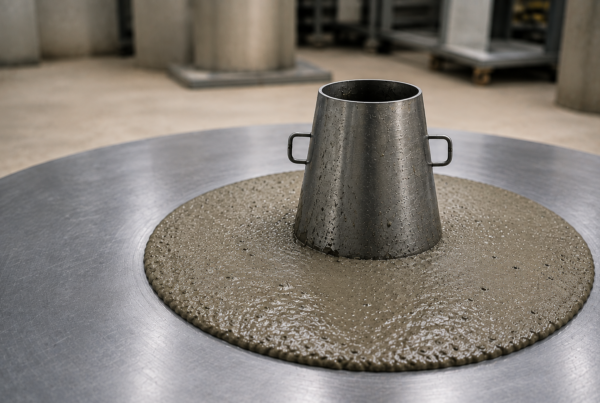
Vibration plays a surprisingly important role in concrete testing and material preparation. When fresh concrete is placed into a mould, small pockets of trapped air can remain between the particles. If these voids are not properly removed, the resulting specimen may not represent the actual quality of the mix. This is why controlled compaction is an important part of producing reliable concrete test specimens.
For laboratories, construction teams, educational institutions and other testing environments, the goal is not simply to make concrete settle. The process needs to be consistent from one specimen to another. Manual compaction can work in some situations, but it can also introduce differences in effort, timing and technique. Mechanical vibration provides a more controlled way to consolidate material and prepare moulds for subsequent testing.
Modern vibrating tables are designed to make this process more consistent by transferring controlled vibration through a rigid table surface to the mould or container placed on it. This helps the fresh material settle, reduces trapped air and supports more uniform specimen preparation. ASTM C1170/C1170M, for example, recognises vibrating-table methods for determining the consistency and density of roller-compacted concrete.
What Is a Vibrating Table?
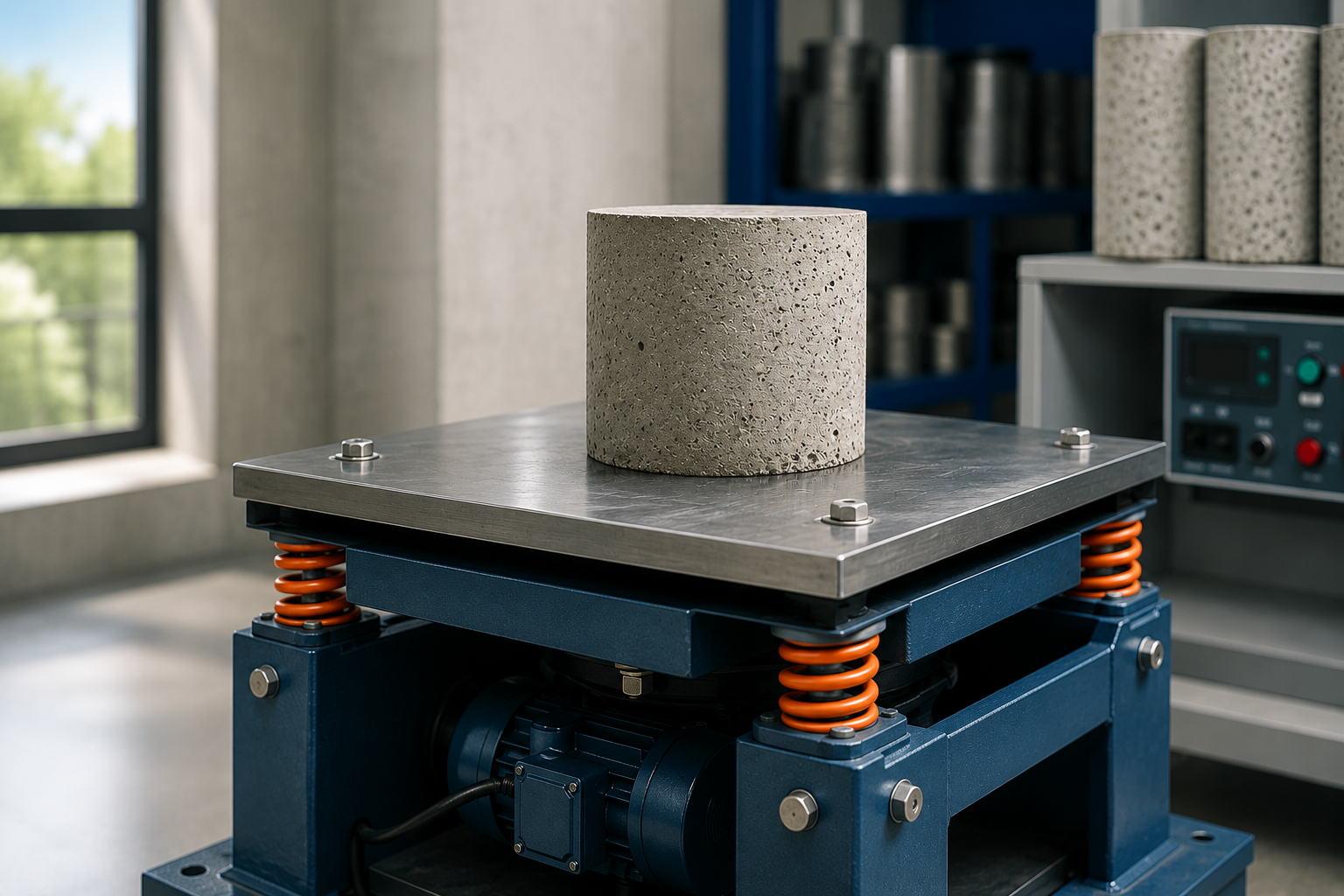
A vibrating table is a mechanical platform that produces controlled vibration across its working surface. A mould, container or other suitable item is positioned on the table, allowing vibration to travel through it and into the material inside.
In concrete testing, the most familiar application is specimen compaction. Fresh concrete is placed inside a mould and the mould is secured or positioned appropriately before vibration begins. The movement helps particles rearrange and settle while allowing entrapped air to move towards the surface.
The basic principle is straightforward, but the quality of the result depends on using appropriate vibration intensity, duration, table size and mould arrangement.
A typical laboratory unit consists of a rigid steel table, a vibration motor, a supporting frame and mounting components that allow controlled movement while keeping the equipment stable. Some configurations also include clamps or retaining arrangements to prevent moulds from moving during operation.
Why Proper Compaction Matters in Concrete Testing
Concrete specimens are often prepared so their later test results can provide information about the performance of the concrete mix. If the specimen is poorly compacted, however, the result can be affected by factors that have little to do with the actual mix design.
Entrapped air can create unwanted voids inside the specimen. These voids may reduce density and can influence the behaviour of the sample during strength testing. A poorly consolidated specimen may therefore give a misleading picture of the material.
Controlled vibration helps improve consistency during specimen preparation. Rather than relying entirely on manual effort, the operator can use a repeatable mechanical process.
This becomes particularly useful when several specimens need to be prepared. Consistency matters because meaningful comparisons require samples to be produced under comparable conditions.
How Does a Vibrating Table Work?
The operating principle is based on mechanical vibration.
A vibration motor generates movement, commonly through an offset or eccentric weight. This movement is transferred to the table surface, which then vibrates the mould or container placed on it.
As the mould vibrates, the fresh material responds to the movement. Particles can settle closer together while trapped air moves through the mix and escapes. The process can produce a more compact and evenly consolidated specimen.
The exact behaviour depends on the material. Concrete mixtures with different workability levels may respond differently to vibration. This is why simply increasing vibration time or intensity is not always better.
The objective is controlled consolidation rather than maximum vibration.
The Role of Vibration in Concrete Specimen Preparation
Concrete can contain air simply because of the way it is mixed, transported and placed. When fresh concrete enters a mould, additional pockets can remain between particles.
Vibration helps overcome some of this problem by encouraging the mixture to settle.
For example, during specimen preparation, a mould can be filled according to the applicable testing procedure and then subjected to controlled vibration. As the material consolidates, its surface may become smoother and the visible signs of trapped air can reduce.
The important point is that vibration should follow the relevant testing procedure rather than being treated as a one-size-fits-all process. Guidance on vibrating-table compaction notes that vibration should continue only for the minimum duration required for full compaction, because excessive vibration can contribute to segregation or loss of entrained air.
Main Applications of Vibrating Tables
Although concrete specimen preparation is one of the most common uses, vibrating tables can support several material-handling and testing applications.
Concrete Cube and Cylinder Moulds
One of the key uses is compacting concrete cube and cylinder moulds before specimens are cured and tested.
Properly prepared specimens are important for strength testing because the sample should reflect the concrete mixture rather than inconsistent moulding practices.
Precast Concrete Components
Small precast products can also benefit from vibration. Vibration encourages fresh concrete to settle into corners and around reinforcement or detailed mould sections where manual compaction may be difficult.
This can improve surface appearance and reduce visible voids when the process is correctly controlled.
Cement and Similar Materials
Depending on the equipment configuration and testing procedure, vibration can be useful for compacting other cement-based materials and mixtures with similar characteristics.
The suitability of a table should always be considered in relation to the material, mould size and required vibration characteristics.
Laboratory Demonstrations and Education
Vibrating tables can also have an educational role. Civil engineering and materials laboratories use concrete testing equipment to demonstrate concepts such as compaction, density, specimen preparation and material behaviour. Concrete laboratories commonly include vibrating tables alongside other testing equipment.
Mould Filling and Casting
Vibration can help material flow into detailed moulds and reduce trapped air. This principle is not limited to concrete. Similar vibration techniques can be used for suitable casting and material-handling applications, provided the equipment is appropriate for the material.
Vibrating Tables and Concrete Strength Testing
It is important to understand that a vibrating table does not directly measure concrete strength.
Instead, it supports the preparation of specimens that may later be subjected to strength tests.
This distinction matters. A compression testing machine, for example, applies a controlled load to a hardened specimen and records its performance. The vibrating table is involved earlier in the process, helping create a properly consolidated specimen.
If specimen preparation varies significantly, the resulting test data can become harder to compare. Consistent compaction therefore forms part of a wider quality-control process.
The principle is simple: better specimen preparation supports more dependable testing.
How Vibration Helps Reduce Air Voids
Fresh concrete contains solid particles, cement paste and water, but it can also contain unwanted air pockets.
When the mould vibrates, the mixture becomes more mobile for a short period. Particles can rearrange, and trapped air can move upwards through the material.
This can result in:
- Improved consolidation
- Greater specimen uniformity
- Fewer unwanted air pockets
- Better filling of mould corners
- More consistent specimen surfaces
- Improved repeatability during sample preparation
However, vibration should remain controlled. Too little vibration may leave voids, while too much can cause unwanted movement of the mixture.
Choosing the Right Vibrating Table
The correct table depends on how it will be used. Buying the largest or most powerful unit is not automatically the best choice.
Several factors should be considered before selecting equipment.
Table Size
The working surface needs to accommodate the moulds or containers being used.
A compact table may be suitable for a small number of specimens, while larger testing operations may need a bigger working area.
Load Capacity
Consider the combined weight of the moulds and material.
The table should be capable of handling the intended load without compromising stability or performance.
Vibration Characteristics
Frequency, amplitude and vibration force influence how a material responds.
The appropriate characteristics depend on the material and the testing or production procedure. A table intended for concrete specimen preparation should provide vibration suitable for that application.
Mould Security
Moulds should remain stable during operation. Some tables use clamps or retaining arrangements to help keep moulds securely positioned.
This is especially important when multiple moulds are being compacted simultaneously.
Power Requirements
Electrical requirements should be checked before installation. Voltage, frequency and phase configuration need to match the available power supply.
Construction Quality
A vibrating table needs to withstand repeated mechanical movement. A robust steel construction and suitable mounting arrangement can help support reliable long-term operation.
Fixed and Portable Vibrating Tables
Not every application requires the same equipment format.
Fixed laboratory tables are generally suited to environments where testing takes place regularly in a dedicated location. They can provide a stable working platform for repeated specimen preparation.
Portable designs are more useful where testing or specimen preparation needs to take place away from a permanent laboratory setup.
The choice comes down to workflow. If the equipment will remain in one laboratory, a fixed configuration may be practical. If the work frequently moves between locations, portability can become much more important.
Understanding Vibration Frequency and Amplitude
Two terms often appear when discussing vibration equipment: frequency and amplitude.
Frequency describes how often the table completes its vibration cycle over a given period. Amplitude refers to the size of the movement.
These characteristics work together. A high frequency does not automatically mean better compaction, and greater movement is not necessarily more effective.
The ideal combination depends on the material and application.
For laboratory work, consistency is often more valuable than simply achieving the highest possible vibration level. The objective is to create repeatable conditions so specimens can be prepared in a controlled manner.
Why Over-Vibration Can Be a Problem
It can be tempting to assume that more vibration will always produce better compaction. That is not the case.
Once sufficient consolidation has been achieved, additional vibration may become counterproductive. Depending on the mixture, excessive vibration can contribute to segregation, where heavier particles and cement paste move differently through the mix.
It may also affect entrained air in concrete where that characteristic is intentionally part of the mixture.
For this reason, vibration should stop once the required level of compaction has been achieved rather than continuing simply because the equipment is running.
Vibrating Tables in Quality-Control Work
Quality control depends heavily on repeatability.
Imagine preparing several concrete specimens from the same batch. If one mould is heavily compacted by hand, another receives minimal compaction and a third is vibrated for a controlled period, the specimens may not have identical preparation conditions.
A vibrating table helps reduce some of this variation.
This does not eliminate the need for proper sampling, mixing, mould preparation, curing and testing procedures. Instead, it provides greater control over one important stage of the process.
Good testing equipment should therefore be viewed as part of the complete testing system rather than as a standalone solution.
Maintenance and Safe Operation
Like any mechanical equipment, vibrating tables benefit from regular inspection.
Before operation, check that the table is stable and that moulds are properly positioned. Inspect electrical connections and the vibration motor for obvious signs of damage.
The table should be installed on a suitable, stable surface. Loose objects should be kept away from moving components.
Regular maintenance can include checking mounting points, fasteners, electrical components and the general condition of the table. Any unusual noise, excessive movement or change in vibration behaviour should be investigated before continued use.
Operators should also follow the manufacturer’s instructions and the relevant laboratory or workplace safety procedures.
Common Mistakes to Avoid
Several simple mistakes can reduce the effectiveness of vibration.
Using Excessive Vibration
Longer vibration does not automatically mean better compaction. Follow the applicable procedure and stop when adequate consolidation has been achieved.
Ignoring Mould Stability
A mould that moves excessively during vibration can affect the process and create unnecessary safety concerns.
Overloading the Table
The combined weight of moulds and material should remain within the equipment’s intended capacity.
Choosing Equipment Without Considering the Application
Table dimensions, vibration characteristics and electrical requirements should all be considered before selection.
Treating Every Concrete Mix the Same
Different mixes respond differently to vibration. Workability, aggregate size and mixture characteristics can influence the required compaction approach.
Where Vibrating Tables Fit Into Modern Testing Workflows
Concrete testing continues to depend on reliable specimen preparation. As construction projects place greater emphasis on quality, durability and material performance, laboratories need repeatable processes that reduce unnecessary variation.
A vibrating table can provide a practical link between fresh concrete preparation and later testing.
The equipment is relatively straightforward, but its value comes from consistency. When the same controlled approach is used across specimens, test preparation becomes easier to repeat and monitor.
This is especially useful for laboratories handling regular batches of concrete specimens.
A Practical Approach to Selecting Equipment
Before purchasing a vibrating table, start by defining the actual workload.
Ask:
- What type of material will be compacted?
- What mould sizes are normally used?
- How many moulds need to be processed at once?
- What total load will be placed on the table?
- Is the equipment required for laboratory or site use?
- What electrical supply is available?
- Does the relevant testing procedure specify particular vibration conditions?
- How frequently will the equipment be operated?
Answering these questions makes the selection process much easier.
For example, a small laboratory preparing only a few cube specimens does not necessarily need a large industrial platform. Conversely, a busy testing facility may benefit from a larger working surface that can accommodate multiple moulds.
Why Equipment Design Matters
A vibrating table needs to balance movement with stability.
The vibration system must transfer sufficient energy to the mould while the table itself remains controlled. Rubber mounts, a rigid platform and suitable motor arrangements can all contribute to effective operation.
Capco’s range includes compact and larger vibrating-table configurations designed for concrete specimen compaction. Its smaller concrete vibrating table, for example, has a 320 × 245 mm working area and is designed for one 100/150 mm cube mould, while its larger model provides a 610 × 610 mm table suitable for four 150 mm cube moulds.
This illustrates why equipment should be selected according to the number and size of specimens rather than simply choosing based on overall machine size.
The Future of Consistent Material Testing
Laboratory testing is becoming increasingly focused on repeatability, traceability and efficient workflows. While digital measurement and automated systems continue to develop, the physical preparation of specimens remains fundamental.
Vibration equipment may look simple compared with more advanced testing machines, but its role should not be underestimated. A test can only be as reliable as the specimen being tested.
As construction materials evolve, laboratories may also work with mixes containing recycled aggregates, alternative binders and other developing material combinations. Research into vibratory compaction continues to examine how vibration affects particle arrangement and material behaviour, including work involving recycled concrete aggregates.
This makes controlled compaction an important consideration not only for conventional concrete testing but also for future materials research.
Conclusion
A vibrating table is a practical piece of equipment that can make a major difference during concrete specimen preparation. By applying controlled mechanical vibration, it helps fresh material settle more uniformly, reduces unwanted air voids and supports consistent mould filling.
Its effectiveness depends on using the right table for the application and following the appropriate testing procedure. Table size, load capacity, vibration characteristics, mould security and power requirements should all be considered before selecting equipment.
Most importantly, vibration should be controlled rather than excessive. The goal is not simply to make the table move. The goal is to achieve consistent and suitable compaction so that the specimen is properly prepared for the testing stage.
For laboratories and testing environments looking for suitable equipment, Capco’s vibrating tables range provides options designed around different specimen sizes and compaction requirements. With the right equipment and a consistent preparation process, laboratories can improve the repeatability and reliability of their concrete testing workflow.